Compound and the function of the twist-off cap
To do this, food must be filled into a jar while hot and immediately sealed with the twist-off cap. The cap seals the jar and the hot air inside cannot escape. As it cools, the entrapped air contracts, causing the internal pressure to drop significantly. This creates a vacuum in the jar, which is maintained by the seal built into the lid. This extends the shelf life of the product for the following reasons:
During the filling process, the high temperature kills or at least reduces bacteria and germs in the contents. This also applies to the enclosed air.
The airtight vacuum created after cooling prevents new germs from the ambient air and prevents further oxygen from entering the container. The lack of oxygen prevents bacteria or mold spores from surviving or spreading.
What is the compound?
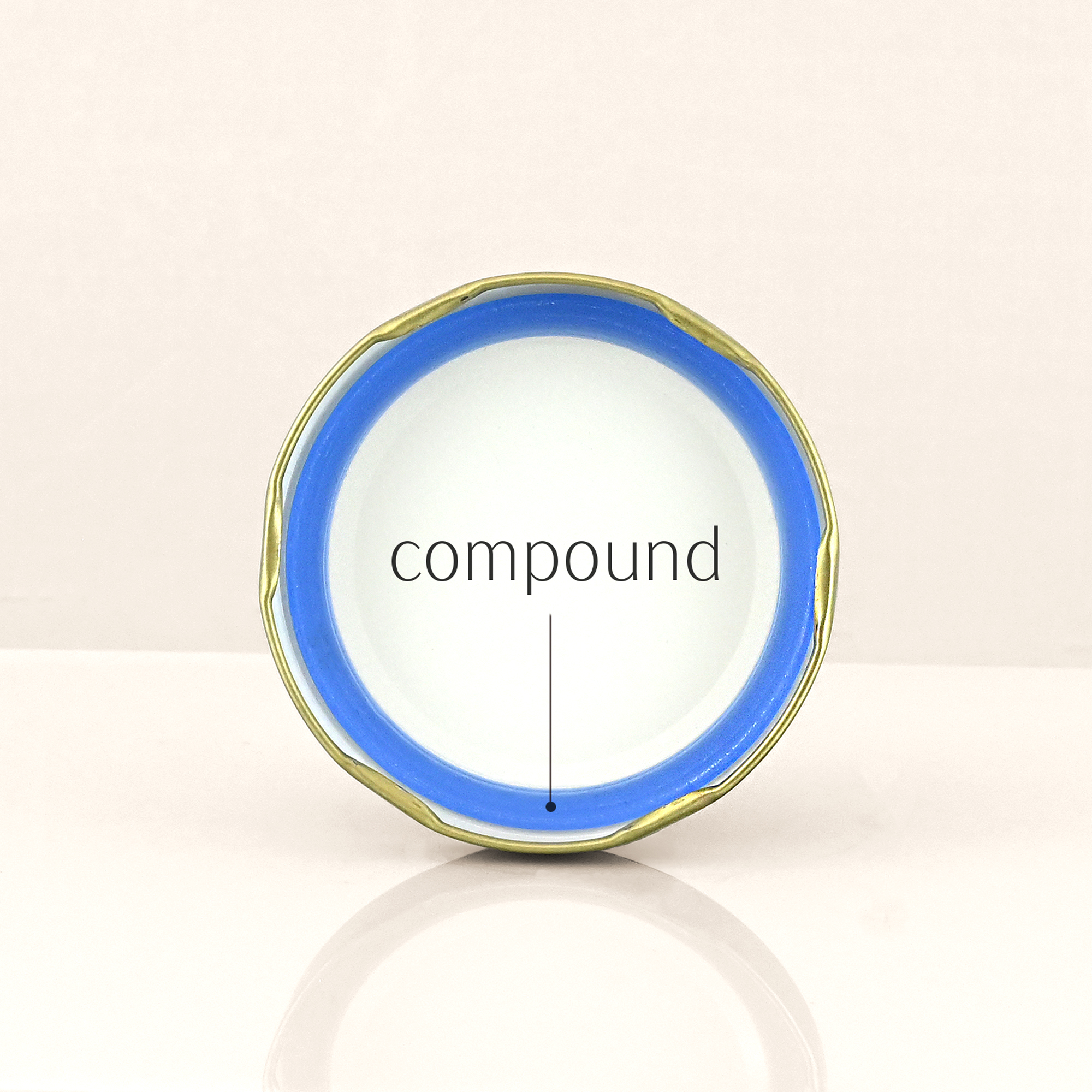
The term “compound” refers to the seal used in the twist-off cap, a plastic ring that ensures an airtight seal on the finish of the closed jar. The compound is a plastic material mixture consisting of various components, which both guarantees suitability for direct food contact and has the physical properties required for the intended use.
Which compounds for which purpose?
Twist-off caps with standard compound for a process temperature of up to 98°C.
Twist-off closures with standard compound are used, for example, for jam, tomato sauce, and pickled vegetables. The base material of the compound is PVC. The material is also slightly foamed, making it somewhat softer and offering greater tolerance during the sealing process. Little or no preheating of the compound is necessary for the mechanical sealing process. Preheating of the compound is recommended for manual sealing.
• Twist-off cap with standard compound and click for process temperatures up to 98°C.
The difference is that this closure is additionally equipped with a vacuum indicator. The vacuum indicator works mechanically based on the
pressure difference between the inside of the jar and the outside environment. In the middle of the lid there is a mark that is easily movable and can be curved up or down. After hot filling and subsequent cooling of the sealed container, this mark is pulled in by the vacuum created inside the jar. When the jar is opened, the seal is broken and the pressure difference is equalized, the vacuum indicator pops back out with a clearly audible “click.” The sound serves as a “freshness seal” of the unopened packaging for the consumer. However, for the vacuum indicator to function, a vacuum must be created during the filling process that is strong enough to pull in the vacuum indicator.
• Twist-off lids with special compound for process temperatures up to 115°C.
Twist-off closures with special compound are suitable for all foods, including fatty or oily foods that are pasteurized or processed at higher process temperatures up to 115°C. These include meat products, for example. The base material of the compound is also PVC, but it consists of a different mixture of additives than the standard compound. The material is not foamed and is slightly harder, which is why the compound must be preheated before the sealing process so that the plastic becomes slightly softer and seals better.
• Twist-off lids with PVC-free compound for cold filling at process temperatures up to 55°C.
Twist-off closures with PVC-free compounds are suitable for all foods. They are particularly suitable for fatty or oily foods, as they tend to release fewer substances into the packaged contents than compounds containing PVC. Lids with this compound are ideal for fatty and oily foods such as pesto, cheese in oil, etc., which are cold-filled and not thermally treated.
• Twist-off lids with PVC-free compound for sterilization with process temperatures up to 121°C.
This closure features a PVC-free compound that is specially designed for hot filling with high process temperatures up to 121°C, which is required for the sterilization of food. It is therefore suitable for food production at high temperatures for long product shelf life as well as for filling processes with subsequent thermal treatment. However, the compound is very hard when cold, which is why preheating to 60-70°C is necessary to make the material sufficiently soft and malleable for the sealing process.
Why does a twist-off lid have a coating?
Twist-off lids require a coating to protect the base material, tinplate, from corrosion. This applies to both the outside and the inside, which comes in touch with the contents.
For contents with acid and/or salt content, the inner coating must be sufficiently strong to protect the material. Our twist-off lids have a strong interior coating, making them suitable for acidic vegetables, for example. The only exception are lids for honey with a corresponding print image (honeycomb, bee, lettering), as honey is not aggressive and does not require a reinforced coating.
Note
As each product and each filling process is unique, the suitability of the packaging material and compliance with the permissible migration limits must be checked and ensured by the food filler, as only they can determine the composition of the finish product, the manufacturing process, and the storage and usage conditions.